
Audit before you spend. If your website or Google Business Profile has problems, fix the issues that could waste leads or reduce visibility. Need calls this month? Google Ads may help you reach people actively searching for your services, provided your budget, landing page and conversion tracking are ready. Review early campaign data after the first week, and measure SEO and local visibility over the following months. Reduce ad spend only when the numbers support it.
I am Khizar Hayat, and I run this process myself for New Braunfels and Hill Country service businesses. Everything below comes from audits and campaigns I have managed, not from a template.
The roadmap at a glance
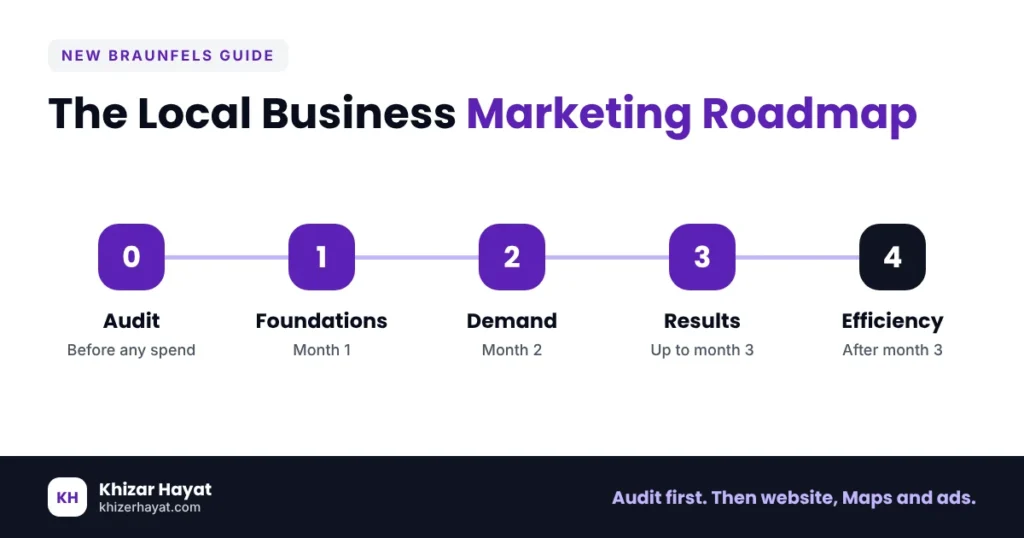
The order is audit, foundations, demand, results, then efficiency. Your starting point decides where you enter it. I explain how I work with clients.
| Stage | When | What happens | What to expect |
| 0. Audit | Before any spend | Website, tracking, phone number, Google Business Profile (31-point check) and any Google Ads account reviewed | A fix list and a recommended first channel |
| 1. Foundations | Month 1 | Website rebuilt around a keyword plan, profile verified and optimized, tracking in place | Nothing to measure yet; this is setup |
| 2. Demand | Month 2 | SEO content goes live, Google Ads start on core services, before and after work posted on social | Ads need 7 days of data before changes |
| 3. Results | Up to month 3 | Calls from the profile, leads from the website and ads | SEO and profile gains become measurable |
| 4. Efficiency | After month 3 | Cut or narrow ad spend where organic leads are steady | I reduced ad spend by approximately 40–50% after the website and Google Business Profile began generating leads |
| 5. Expand | When one channel performs | Add the next channel or nearby cities, and plan budgets around your busy season | Slower and steadier than the first quarter |
The timelines come from what I tell clients, not from a guarantee. Results depend on your market, budget and competition.
What do I find when a New Braunfels business first calls me?
Usually one of three situations, and often all three at once. Each one points to the first fix.
1. The website looks dated and was built without a plan. It is a template layout with no keyword research or content plan behind it. There is a home page and a few pages stuffed with keywords that do not match what people actually search for. When several pages target the same search intent, they can compete for visibility and make it harder to establish which page best serves the searcher. I review their purpose and consolidate or differentiate them where needed.
2. The Google Business Profile has been left alone. It is not optimized, and the name, address and phone number do not match across the web. There are no reviews from real customers, and the few reviews that exist get no reply. The photos are old or generic, and sometimes they were taken from another business’s profile or a free template site. Customers may lose trust when business information looks outdated or inconsistent. Google explains that complete, accurate business information helps businesses appear in relevant local results, although visibility also depends on factors such as relevance, distance, and prominence.
3. The Google Ads run without tracking or targeting. There is no proper conversion tracking, so nobody knows which clicks became calls. The ads run on broad terms that have little to do with the services the business sells, so the budget leaks on searches that were never going to buy.
The fix for each problem is also the order of the roadmap: plan and rebuild the site, repair the profile, then tighten tracking and ads.
What should you check before you spend a dollar on marketing?
Check four things: your website, your phone number, your Google Business Profile and any ad account you already have. I do this audit first with every business, before any budget is set.
Website. I check that tracking is installed and working, that every call to action does something, and that click-to-call works on a phone. Then I find out where leads actually come from today, for example forms, calls or bookings. If the site cannot record a lead, nothing you spend later can be measured.
Phone number. It has to be the same number everywhere, it has to be answered, and calls need to be trackable. A missed call from a paid click is the most expensive kind of waste.
Google Business Profile. I run a 31-point checklist covering categories, services, photos, reviews and replies, and consistent name, address and phone details. Google says businesses with complete and accurate information are more likely to show in local results, so this is where small gaps cost the most (Google Business Profile Help).
Google Ads account (if one exists). I check conversion tracking, which search terms trigger the ads, location targeting and negative keywords. This is where I usually find budget going to searches that never had a chance to buy.
The result is a short fix list and an honest recommendation for the first channel. Sometimes that recommendation is to fix the foundations and not spend on ads yet.
Which channel should a local business start with?
Start with the one that matches your situation: website and profile if you want steady organic calls, Google Ads if you need calls now. I decide after the audit, based on what the business already has and how fast it needs customers.
| Your situation | Start with | Why |
| You already have a website and profile and need them to perform | Website and Google Business Profile | Fixing what exists is the cheapest way to get more calls, and it keeps working without paying per click |
| You need calls this month | Google Ads | Local buyers are already searching for your service, and ads put you in front of them immediately |
| You are starting with a weak site and no profile | Foundations first, ads in month 2 | This was the home maintenance order: site and profile in month 1, ads and SEO in month 2 |
Why Google Ads work well for local businesses. The people searching “AC repair” or “bathroom renovation” near you are already looking to hire. You do not have to create demand, only appear when it shows up, which is what Google Ads management is for.
What does it cost to start? The ad budget depends on competition and cost per click in your trade. As a starting point, I recommend at least $1,000 a month in ad spend. That is the money paid to Google, not my fee. My management plans are listed, so you can see both costs separately.
Can you pay Google for a better Maps ranking? No. Google states there is no way to request or pay for a better local ranking (Google Business Profile Help). Ads and the Maps profile are separate channels, and they work best together.
What happens in each stage?
Each stage builds on the one before it, so the order matters more than the speed.
Stage 1: foundations (month 1).
- Website. I do local keyword research and build a content plan, then a custom WordPress website where each page has one clear job. Pages that compete for the same keywords get separated or merged. My complete website guide covers the process in full.
- Google Business Profile. I apply for and verify your Google Business Profile if it does not exist, list the services the business actually offers, and optimize the rest. If it exists, the work is cleaning up details, photos and review replies.
- Tracking. Calls and form submissions are tracked from day one, so every later decision rests on data.
- Social accounts. I set them up so there is a place to post proof of the work.
Stage 2: demand (month 2).
- SEO. The service pages and supporting content go live and start earning impressions through local SEO work.
- Google Ads. Campaigns start on the core services only. I give them 7 days to collect data before making changes, then optimize from what the data shows.
- Social proof. For trades like home maintenance, before and after work is the most convincing thing you can post.
Stage 3: results (up to month 3).
- Calls arrive from the profile and leads arrive through the website, alongside the ad leads. This is when I compare channels and decide where the budget should go next.
The pattern is the same in any local trade: make it easy to be found, easy to trust and easy to contact, then pay to speed it up where the numbers justify it.
How long until you see results?
Google Ads give you data within a week. SEO and Google Business Profile improvements can become measurable over several weeks or months. The timeline depends on your website, existing visibility, competition, and the work required. I monitor progress and adjust the strategy based on the data rather than promising a fixed deadline. These are the timelines I give every client.
| Channel | What to expect | What I tell clients |
| Google Ads | Clicks and calls start quickly | Give it 7 days to collect data. Ads are testing, so we learn first and optimize from the data |
| Google Business Profile | Calls and profile activity build up | Up to 3 months for measurable improvement |
| Website and local SEO | Rankings and leads build more slowly | Up to 3 months for measurable improvement, then it keeps compounding |
In the first 7 days of a campaign I am not judging results, I am collecting the evidence to make the first round of changes. Any provider who promises page one in a few weeks is guessing. I do not guarantee rankings or lead numbers, and I will tell you on the first call if your market, budget or timing is a poor fit.
When should you cut your ad spend?
When the website and Google Business Profile already bring steady leads, you can often cut the ads by a large share or keep them only on your highest-intent searches. I recommend it because the goal is customers at the lowest cost, not the biggest budget.
How I decide. I look at where leads come from and talk to the owner about the business. If the website and profile are producing good leads, I recommend one of two options: cut the ads completely, or keep ads only on high-intent searches such as emergency and “near me” queries.
Why keep any ads at all? On many local searches the page shows ads first, then the Maps listings, then website results. If you can carry the cost, ads on your best searches still capture people who click the first thing they see, which your free listings would miss. Whether it pays depends on your margins and your lead volume.
A real example. One home maintenance client came to me with a website only: no Google Business Profile, no Google Ads account and no social presence, and every page competed for the same keywords. The focus services were painting, bathroom renovation, HVAC and AC system maintenance, bathroom tile and marble, and electrical work.
- Month 1. I rebuilt the website around local keyword research, got the profile approved and set up the social accounts.
- Month 2. SEO work continued, and Google Ads and social posting of before and after work began. The ads produced the first leads.
- By the end of month 2. Calls started arriving from the Google Business Profile and leads from the website, alongside the ads.
- After month 3. I cut the ad budget by 40 to 50% and kept ads only on the highest-intent, most business-relevant keywords, because the profile and website were already generating leads.
How do you get mentioned in Google AI Overviews and ChatGPT?
There is no single switch. I work on everything that makes a business easy to find, understand and trust, because AI answers draw on a combination of signals, not one ranking rule.
What Google says. Google states that no special optimization, markup or files are needed to appear in AI Overviews or AI Mode. A page must be indexed and eligible to show with a snippet, and Google recommends helpful, people-first content, good page experience, internal links and important content kept in text. It also says any structured data should match what is visible on the page, and that Business Profile information should be kept current (Google Search Central). So the foundation is the same good local SEO as before.
What I do on top of that:
- Answer first. Each page opens with a short, direct answer to the question a customer is asking, followed by headings written as real questions.
- One page, one job. Clear service pages for each service and area, so a search or an AI tool can tell exactly what you do and where.
- Real FAQs. Questions customers actually ask, answered plainly on the page.
- Consistent business details. The same name, address and phone number on your website, Google Business Profile and other listings.
- Reviews and replies. Real customer reviews that mention the service and the city, and a reply to each.
- First-hand proof. Real photos, real examples and numbers from work you have done, not generic text that fits any business.
What about E-E-A-T? Google says E-E-A-T (experience, expertise, authoritativeness and trustworthiness) is not itself a ranking factor, but the signals that show it are useful, and trust matters most of the four. Google also asks whether it is clear who wrote the content. That is why this post carries a named author and real client examples (Google Search Central).
No one outside the platforms can promise a place in AI answers, and I do not. I can make sure your business is the easiest one to find, understand and trust.
What mistakes should you avoid?
The costliest mistakes are spending before you can measure and publishing before you have a plan. These are the ones I see most.
- Running ads with no conversion tracking. If you cannot tell which clicks became calls, you cannot tell what is working.
- Bidding on broad terms. Ads on searches that do not match your services burn budget on people who will never hire you.
- Stuffing keywords into a few pages. When several pages target the same search, they compete with each other and none of them ranks well.
- Using stock or borrowed photos. Old, generic or copied images make a profile look unreal. Use your own work.
- Ignoring reviews. Collect reviews from real customers and reply to every one.
- Judging results too early. Ads need about 7 days of data before changes, and SEO and your profile need up to 3 months.
- Keeping the full ad budget after organic works. Look at where your leads come from, then decide what the ads still need to cover.
- Buying reviews or promises of page one. Google can remove bought reviews, and nobody can guarantee a ranking.
Frequently asked questions
How much should a New Braunfels business spend on Google Ads to start?
I recommend at least $1,000 a month in ad spend, which is paid to Google and is separate from my fee. The right amount depends on competition and cost per click in your trade.
Should I start with SEO or Google Ads?
If you need calls this month, start with Google Ads. If you already have a website and profile and want steady calls without paying per click, start by fixing those. After the audit I recommend one or two channels, not everything at once.
How long does local SEO take?
Up to three months to see measurable improvement in your website and Google Business Profile. I do not promise rankings or a set number of leads.
Do I need a Google Business Profile if I already have a website?
Yes. The profile is what people see in Google Maps and local results before they visit your site, and Google says complete, accurate information makes a business more likely to appear.
Can I stop running ads once my website ranks?
Sometimes. If the website and profile produce steady leads, you can cut the ads or keep them only on high-intent searches like emergency and “near me” queries. I check where your leads come from before recommending it.
Can I ask for the audit first, with no commitment?
Yes. The free 30-minute consultation includes a review of your website, profile, competitors and any current ad spend.
Where Should You Start?
Start with an audit, not a bigger marketing budget.
In a free 30-minute consultation, I review your website, Google Business Profile, competitors, and current advertising setup. You’ll leave knowing which one or two channels deserve attention first, based on your goals and budget.
Book your free consultation and get a practical starting plan for your New Braunfels business, whether or not we decide to work together.