
A local service business needs a website that explains its services clearly, works well on mobile devices, makes it easy for customers to call or request a quote, and supports its local search visibility. Start with keyword research and competitor analysis, plan pages around your actual services and service areas, and configure analytics and search tracking before launch where possible.
Website design packages are available at $449, $997, and $1,399 as one-time payments, with launch timelines of up to 7, 14, and 25 days, respectively. The right option depends on your page requirements, content needs, and growth plans.
Why Your Website Matters for a Local Service Business
When someone searches for a service in New Braunfels, San Antonio, San Marcos, Seguin, or another Central Texas community, your website can help them decide whether to contact you.
A useful website should answer the questions customers have before they call:
- What services do you provide?
- Which locations do you serve?
- What makes your business a suitable choice?
- How can someone request a quote or schedule a service?
- What should customers expect when they contact you?
A website is not just an online brochure. It should make your services understandable, build confidence, and give potential customers a clear next step.
However, having a website alone does not guarantee visibility or leads. Results also depend on your market, competition, service demand, website quality, and broader marketing activity.
What Should a Local Service Business Website Include?
The pages your website needs depend on the services you provide, how customers search for them, and the areas you genuinely serve.
| Page type | Purpose |
|---|---|
| Homepage | Explain your main services, location, value proposition, and next step |
| Service pages | Describe each important service, its benefits, and how customers can request it |
| About page | Introduce your business, experience, process, and relevant credentials |
| Contact page | Provide phone, contact forms, service-area information, and other useful contact details |
| Location pages | Explain your services in specific areas where you genuinely operate |
| Blog or resource pages | Answer relevant customer questions and provide useful information |
| Trust-building pages | Present relevant project examples, qualifications, guarantees, or testimonials where applicable |
Not every business needs every page from the beginning. Prioritize pages that help customers understand your services and make an informed decision.
Should You Create Separate Service Pages?
Yes, when the services have distinct customer needs or search intent.
For example, a garage door business may need separate pages for garage door repair, spring replacement, opener repair, and new garage door installation. Each page should explain the relevant service rather than repeating nearly identical copy.
This makes the website more useful to visitors and gives search engines clearer information about what the business offers.
Should You Create Separate Location Pages?
Create location pages when your business genuinely serves those areas and you can provide useful, location-relevant information.
A business serving New Braunfels, Seguin, and San Marcos might have separate pages if it has relevant service information for each location. Avoid creating large numbers of near-identical pages that only replace the city name. Each page should offer a real reason for customers in that area to visit it.
How to Build a Website for a Local Service Business
A practical website project follows a defined process. The exact steps vary depending on the size of the website, available content, and technical requirements.
| Step | What happens |
|---|---|
| 1. Business and competitor research | Review services, target customers, local search demand, and relevant competitors |
| 2. Website planning | Decide which pages are needed and what each page should accomplish |
| 3. Content and keyword mapping | Assign relevant topics and search intent to the appropriate pages |
| 4. Design and development | Build the website using WordPress, a suitable page builder, custom code where necessary, or a combination |
| 5. Conversion setup | Add clear calls to action, contact forms, and click-to-call links where appropriate |
| 6. Technical and on-page SEO | Configure page titles, headings, internal links, relevant schema markup, and other appropriate settings |
| 7. Testing and tracking | Check mobile usability, forms, links, performance, analytics, and search tracking |
| 8. Launch and improvement | Publish the website and use real performance data to identify improvements |
The goal is not to add every possible feature. It is to build a website that meets the business’s needs without introducing unnecessary complexity.
Is a Template Website a Bad Choice?
Not necessarily. A template or page builder can be a practical option when it provides the necessary functionality, design flexibility, and performance.
The important considerations are whether the finished website represents your business, supports your services, works well on mobile devices, and gives visitors a clear path to contact you.
Custom development can be useful when the project requires functionality or design control that existing tools cannot provide efficiently. The choice should depend on the project requirements, not the assumption that every template is unsuitable.
Which Website Platform Should You Use?
WordPress can be a practical choice for local service businesses because it supports service pages, blog content, forms, and a wide range of integrations. A suitable page builder may help speed up development, while custom code can be used where necessary.
The platform matters, but the implementation matters too. Poorly configured themes, excessive plugins, unnecessary scripts, and unoptimized images can affect performance and maintenance.
Choose tools based on the website’s actual requirements instead of installing features you do not need.
Website Speed, SEO, and Tracking
A professional website should be usable on mobile devices, load efficiently, and make important information easy to find.
Google considers multiple signals when generating search results. Page experience and Core Web Vitals can be relevant, but strong performance scores alone do not guarantee high rankings.
Before launch, where access and implementation permit, configure the following:
- Google Analytics: Measures website activity and configured interactions, such as form submissions or relevant events.
- Google Search Console: Helps monitor search performance, indexing, and technical search-related issues.
- Bing Webmaster Tools: Provides search performance and diagnostic information for Bing.
- Relevant schema markup: Helps describe eligible business or page information in a structured format.
- Contact tracking: Test forms, phone links, and other conversion actions that matter to the business.
These tools serve different purposes. Google Analytics and Google Search Console are not interchangeable, and installing them does not automatically guarantee that every lead or conversion will be tracked correctly. Tracking must be configured and tested for the actions you want to measure.
Does a New Website Rank Immediately?
No. A newly launched website may need time to be discovered, crawled, and indexed. Rankings and lead generation depend on more than the website launch itself.
After launch, useful next steps may include improving service pages, addressing technical issues, publishing genuinely helpful content, earning relevant links, and strengthening your local business presence.
Social media can help distribute content and build awareness, but posting on social platforms should not be treated as a guaranteed Google ranking factor.
How Much Does a Website Cost in Central Texas?
Website costs vary according to the number of pages, design requirements, content creation, functionality, and SEO setup.
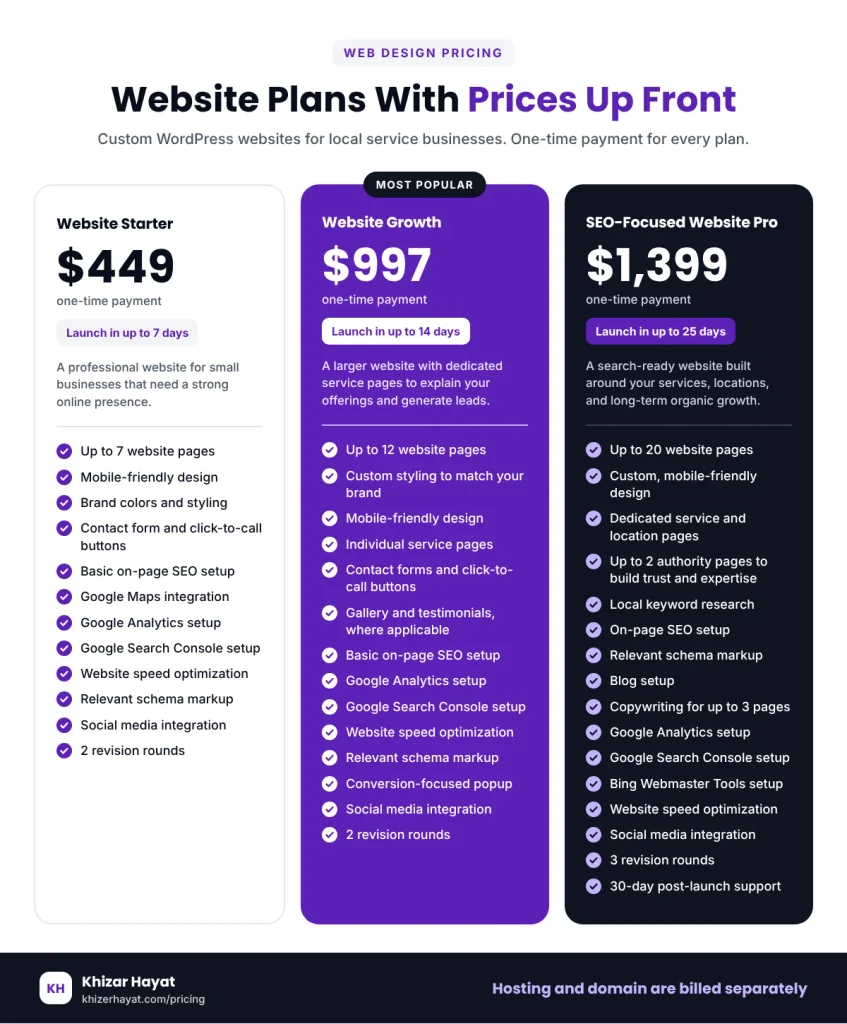
For small businesses that need a professional website, these are the three website design packages offered by Khizer Hayat.
| Package | Price | Page limit | Launch timeline |
|---|---|---|---|
| Website Starter | $449 one-time | Up to 7 pages | Up to 7 days |
| Website Growth | $997 one-time | Up to 12 pages | Up to 14 days |
| SEO-Focused Website Pro | $1,399 one-time | Up to 20 pages | Up to 25 days |
The timelines are stated as up to the specified number of days. Actual completion depends on the project scope, content readiness, access to required accounts, feedback, and approvals.
1. Website Starter — $449
The Starter package is designed for small businesses that need a professional online presence without requiring a large website.
It includes:
- Up to 7 website pages
- Mobile-friendly design
- Brand colors and styling
- Contact form and click-to-call buttons
- Basic on-page SEO setup
- Google Maps integration
- Google Analytics setup
- Google Search Console setup
- Website speed optimization
- Relevant schema markup
- Social media integration
- 2 revision rounds
Launch timeline: Up to 7 days.
This package is suitable for a business that needs its core services, business information, and contact options presented clearly online.
2. Website Growth — $997
The Growth package is designed for businesses that need a larger website with dedicated service pages to explain their offerings and generate leads.
It includes:
- Up to 12 website pages
- Custom styling to match your brand
- Mobile-friendly design
- Individual service pages
- Contact forms and click-to-call buttons
- Gallery and testimonials, where applicable
- Basic on-page SEO setup
- Google Analytics setup
- Google Search Console setup
- Website speed optimization
- Relevant schema markup
- Conversion-focused popup
- Social media integration
- 2 revision rounds
Launch timeline: Up to 14 days.
This package can suit businesses that offer multiple services and need more room to explain each offering separately.
3. SEO-Focused Website Pro — $1,399
The SEO-Focused Website Pro package is designed for businesses that need a larger website organized around their services, relevant locations, and long-term organic growth.
It includes:
- Up to 20 website pages
- Custom, mobile-friendly design
- Dedicated service and location pages
- Up to 2 authority pages to build trust and expertise
- Local keyword research
- On-page SEO setup
- Relevant schema markup
- Blog setup
- Copywriting for up to 3 pages
- Google Analytics setup
- Google Search Console setup
- Bing Webmaster Tools setup
- Website speed optimization
- Social media integration
- 3 revision rounds
- 30-day post-launch support
Launch timeline: Up to 25 days.
This package is intended for businesses that need more extensive page planning, local keyword research, and a stronger foundation for future SEO work.
The included keyword research and on-page SEO setup are not the same as ongoing SEO management. Organic rankings are not guaranteed, and ongoing SEO work may require a separate engagement.
Which Website Package Is Right for You?
Choose based on the website you need now, rather than selecting a package only because it has more pages.
- Choose Starter if you need a professional website with the essential business information and contact features.
- Choose Growth if you need more pages and individual pages for your different services.
- Choose SEO-Focused Website Pro if you need a larger website with dedicated service and location pages, local keyword research, and additional content support.
The page limits refer to the maximum number of website pages included in each package. Confirm the exact page list and deliverables before work begins.
The listed package prices are one-time payments. Confirm any applicable domain renewal, hosting, ongoing maintenance, or third-party subscription costs separately before starting the project.
What to Check Before Hiring a Website Designer
Price is only one part of choosing a website designer. Before committing, make sure you understand what the package includes and who will be responsible for the website after launch.
Ask these questions:
- How many pages are included?
- Are service pages and location pages included?
- Is copywriting included, and for how many pages?
- Will the website work properly on mobile devices?
- Are analytics and search tracking configured and tested?
- Who owns the domain, hosting account, and website assets?
- Are revisions, post-launch support, and ongoing maintenance included?
- Are there any recurring costs or third-party subscriptions?
Also ask how the designer will handle website access, backups, security, performance, and future updates. The right answers depend on the project, but the responsibilities should be clear before the work starts.
Should You Redesign Your Existing Website or Build a New One?
A redesign may be suitable when your current website has a sound technical foundation but needs better design, navigation, content, or conversion paths.
A new build may make more sense when the existing site has major technical limitations, an unsuitable structure, or a platform that no longer meets the business’s needs.
Before replacing a website, review its existing search traffic, important pages, backlinks, and conversion performance. Preserve valuable content and plan appropriate redirects when URLs change. Rebuilding a site without accounting for its existing search value can create avoidable problems.
Sometimes, improving a few important pages is a better first step than replacing the entire website.
Why Local Website Planning Matters in Central Texas
Central Texas includes different communities, customer needs, and competitive environments. A business targeting New Braunfels may have different search opportunities and competitors from a business serving San Antonio, Seguin, or San Marcos.
The San Antonio–New Braunfels metropolitan area had a population of approximately 2.56 million in the 2020 Census. That figure is historical rather than a current population estimate, but it illustrates the scale of the broader regional market.
Your website should reflect the locations you actually serve. That may mean creating relevant service-area pages, explaining your availability, and making contact options easy to find.
Local research is also important because website pricing and project scope vary by provider. A published price from one San Antonio studio, for example, should be treated as that studio’s pricing—not as the average cost of website design across Central Texas.
For businesses in New Braunfels and surrounding communities, a well-planned website can provide a foundation for local search visibility and future marketing. Its effectiveness still depends on the quality of the implementation and the wider marketing strategy.
Frequently Asked Questions
How much does a small business website cost?
The website design packages are $449 for Website Starter, $997 for Website Growth, and $1,399 for SEO-Focused Website Pro. All three are listed as one-time payments. The right option depends on the number of pages, required features, content needs, and SEO setup.
How long does it take to build a business website?
The listed launch timelines are up to 7 days for Website Starter, up to 14 days for Website Growth, and up to 25 days for SEO-Focused Website Pro. Actual timing depends on project requirements, content readiness, access, feedback, and approvals.
Does every local service business need location pages?
No. Location pages are useful when a business genuinely serves multiple areas and can provide relevant information for each one. Avoid publishing repetitive pages that offer little value beyond changing a city name.
Is on-page SEO included in the website packages?
Basic on-page SEO setup is included in Website Starter and Website Growth. SEO-Focused Website Pro also includes local keyword research, dedicated service and location pages, relevant schema markup, and copywriting for up to three pages. Ongoing SEO management is not stated as an included package feature.
Will a new website automatically rank on Google?
No. A website can provide a strong technical and content foundation, but rankings depend on multiple factors, including relevance, competition, content quality, and search engine discovery and indexing. No website designer can guarantee a particular ranking simply by launching a website.
What should I prepare before a website project starts?
Prepare your business information, service list, service areas, contact details, brand assets, photos, and any relevant credentials or testimonials. Also identify the main action you want visitors to take, such as calling, requesting a quote, or booking a consultation.
Can I improve my website without rebuilding it?
Yes. If the existing site is technically sound, improving key service pages, mobile usability, calls to action, content, and tracking may be more practical than starting over. Review the current site’s performance before deciding,
Need a Website for Your Central Texas Business?
If your website is outdated, difficult to use on mobile, or not explaining your services clearly, the first step is to identify what is holding it back. Khizer Hayat offers website design packages for local service businesses, with one-time prices of $449, $997, and $1,399. You can discuss your requirements and decide which package fits your current needs.
Book a free consultation to review your website, services, local search presence, competitors, and advertising setup. The goal is to identify whether you need a new website, targeted improvements, or a stronger marketing plan.